INTRODUCTION:
I'm constantly meeting people at the track who are really good riders, in an effort to ride faster they are constantly attending track days, practice and test days.
From my perspective and frustratingly I notice that there improvements are or have plateaued, in other words there progression via the lap times has stopped reducing yet they have a way to go before they can reach the leaders of the pack.
In many instances they ask themselves. Why are the leaders of the pack that much faster? and they just keep on pushing harder, often resulting with crashes that dents confidence, injures riders and breaks bikes.
Often when I ask what adjustments they are testing the answer that comes back is " nothing, I bought a new shock but haven't changed anything since I've had the bike". "Not even the clickers" I ask. "Nope same settings that arrived with the shock"
In this case the shock came built for the specific bike/rider and from a fantastic supplier so he was lucky.
So I'm going to write a few articles via this web site and hopefully help some keen racers and maybe raise my own service work.
I need to state that in some instances or all instances, you may not agree with me, that's fine but just go and do your own thing,
The topic is so intense, to the extent that at the higher levels of competition riders have race engineers who have mastered the complexities and can avoid getting bogged down with progression. If you spoke with these engineers I imagine they would admit to sometimes still losing there way a little but experience has taught them how to return to base camp.
However at our levels we just go to the track and blast around, having fun, We must be competitive and progressive people or we wouldn't do it. We travel on our bikes at speeds that make calculations of all the parameters immediate, which in turn accelerates our confidence and competitive nature.
Many will trawl the internet for bike information and riding techniques, some will attend rider race training, a huge benefit to all racers. I have known many hugely successful racers who constantly have rider training. If you like it is like a professional golfers swing, the golfers are constantly monitoring the process from A-Z.
However there are many that don't, they often don't know where to start, it is these people that I hope will benefit from my writings.
CAUTION:
Always stay focused on the fact that as your speed increases or lap times decrease, so will the need to adjust bike settings, suspension and rider position. If when you go to the track day you are not trying changes to set up but simply putting fuel in the bike, checking tyre pressures and maintaining things like brakes and tyres then you are never going to improve or catch those front runners, An inadequacy in your suspension set up may (when compared to a faster rider) presently not be an inadequacy. So learn not to jump from pillar to post, dont change something simply because Joe has and he is faster than me. Go to the track day with a plan, don't go with the intention of lowering lap times, these will come down as you improve the setup which in turn will give you later braking points, easier turn in under braking, faster mid corner speed, getting on the gas earlier through better traction and steering and higher straight line speeds.
We love to race, and I think we all would love to race at the front.
It is my intention to write articles that give conclusions without leaving the reader wondering what to do next, as mentioned the process is complex and one is constantly making trade-offs between the front of the bike (STEERING) and the rear of the bike, ACCELERATION.
So in conclusion hopefully I can write is such a way and with progression that the reader will gain an understanding and master some of the complexities.
First thing the rider (Racer) needs is a note book, there are some simple headings you can include and these I will cover and give examples with my first article. At first you may find this notebook a waste of time, please persevere, it will give great reward and often when you become lost in the myriad of settings you will have a reference of which you can return to.
Try to avoid simply scribbling notes as these a month later can lose there meaning or be lost in translation.
Regards Leigh Paulin.
FIRST ARTICLE STILL TO COME: we will include the following.
1) Starting a note book.
2) Simple headings or records.
3) A short and simple overview of possible handling scenarios with suggestions of symptoms and corrections. The intention is to give you a quick reference page for the track and to lay the foundation for better understanding of dynamics..
USING THE NOTEBOOK
It all begins with an idea.
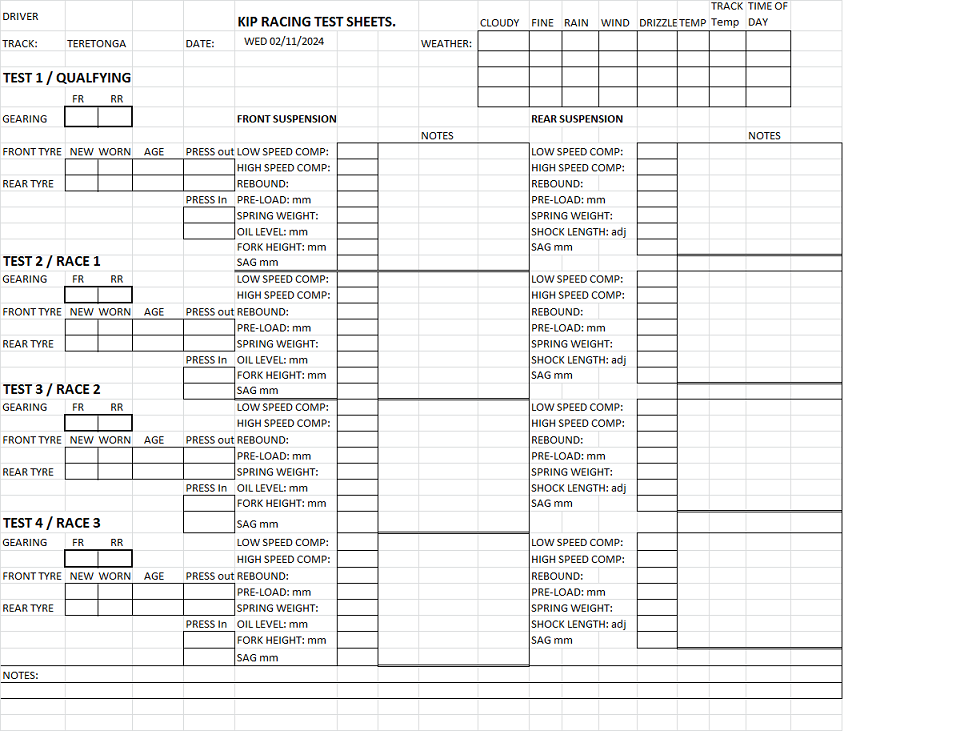
Okay off to the shop to geet my notebook, wait, “Notebook” make it more of a book than a soft covered notebook. Hopefully it will last you for years so it needs to be sturdy and large enough to record a days racing on one page. Often there may be more than one bike so the book may need sectioning so think about a hard covered book. Some use a clip board with specific sheets that they staple into a book form etc.
Now you need to have various headings and room to write info and make notes. Items to consider are following but with experience you will reference to your needs.
Start with. LOCATION: DATE: WEATHER: AIR TEMP: TRACK TEMP:
BIKE: GEARING:
TEST / RACE 1
FRONT TYRE NEW WORN AGE PRESSURE - OUT PRESSURE - IN
REAR TYRE NEW WORN AGE PRESSURE - OUT PRESSURE - IN
FRONT SUSPENSION: LOW SPEED COMP: HIGH SPEED COMP: REBOUND: PRE-LOAD: SPRING WEIGHT: OIL LEVEL: FORK HEIGHT: SAG:
REAR SUSPENSION HEADINGS SAME AS FRONT: Have 3 or 4 sections for Tests or Race like TEST / RACE 2 TEST / RACE 3 etc.
PERHAPS IT WILL LOOK LIKE THIS
Lets Consider a few notes: Why record tyre pressure OUT and Tyre pressure IN. Okay if a tyre comes in at a different pressure than what you go out on then the handling of your bike will change during the race, As the pressure changes the bike may come to you (get better) or go away from you. If you know the PSI changes then any suspension / geometry changes etc will help you with understanding performance gains or losses. Its interesting to listen to riders adding a lb of pressure or taking a lb out yet what happens during the race appears to be irrelevant.
Most Racers will heat tyres on warmers to a setting of around say 80*C. This is the setting of the warmer, not the heat in the tyre and also consider the surface of the tyre, that which sits next to the heating element will be much hotter than the rubber 1mm under the surface. Now consider the 2 min call sends you into activity and you ride out to the dummy grid and sit for say 3 minutes, now you ride the out lap, dawdling around behind all those early bikes that present themselves to the starter. Now you wait for another 3 or more minutes while stragglers find there Grid spot. You may notice some “RACERS” time the track entry just before the track closure, they now have clear track, able to keep the pace up on the out lap, roll to grid position and have minimum delay prior to race start.
So now guess which riders or pits crews are monitoring out and in pressures and temperatures and who clearly have a strategy. Consider different Tyre compounds as well and the recorded information just may help you understand if the tyre is better or worse for given track temperatures, There is no limit to the advantages you gain from having a note book.
NEXT TRACK DAY why not focus on a section of performance, be it tyre temperature, tyre pressure, sensing through your feed back on track what is happening, this to is a learnt process, recording notes for you and your PITT-CREW to chew over, don’t have a PITT-CREW, consider getting someone, I am sure you will all have friends chomping at the bit to help your racing and one things an absolute known. “You cant do it on RACE TIME.”
SEE the next blog: UNDERSTANDING your BIKES GEOMETRY 1. coming soon, give us a few likes and the update will come sooner rather than later.

LATEST BIKE BUILD: F3 or sportsbike#
It all begins with an idea.
FOLLOW out LATEST F3 bike build using a YAMAHA R7 donor bike. .
It all begins with an idea. Follow this blog for updates on the latest bike Build.
Firstly take a Yamaha YZF R7 2022 and strip it completely. Then do some removing of unwanted frame parts, (Photo1) Then from past knowledge visiting teams overseas we learnt that to put a suitable stroke shock with a reasonable Top-Out spring we needed to have more room and so while the Sub-Frame is left intact at the chassis, modifications to allow for the shock and Link-Arm and later fitting of fairings is comprehensive. Then the Link-Arm came under scrutiny as well, when we plotted the Link Arm Travel it became apparant the speed towards the later part of shock travel was to fast and so modifications were made.
The Swing arm came under attention as well, the swing arm flex is way to much, the flex comes very early on in the corner dynamics and adding an extra bearing helps to reduce this flex, the the swing arm mounting within the frame is nothing more than production shop basics so this came under scrutiny and modifications as well. While at it lets make the pivot point adjustable height wise.
All modification items are available through the KIP web page.
That brings us up to date, stay tuned, as we progress with the build.
understanding suspension.
It all begins with an idea.
This is written for those that are perhaps considering track days or advancing their skill sets, maybe even racing. Maybe wondering about adopting change to advance there riding pleasure.
Firstly the reader needs to be aware that so called suspension technicians could put you in hospital. the first thing a technician needs is not only many specialized tools but also a Suspension Dyno but WAIT, THIS ISN’T ENOUGH as just having a Suspension Dyno at your side also requires having huge amounts of Data and experience that takes Tens of years to develop and store. Called knowledge. Most successful technicians will be older and because it has taken years and large amounts of money to store there knowledge they are often reluctant to share.
So if you are thinking about approaching a technician without a Dyno, in most cases don’t go there and if they have and are new to the game then be very cautious as there is so much more to all aspects than just having equipment. Sure if all you require is servicing of your suspension and this should be done regularly but if you are considering more then be very cautious.
Why would you need to consider more you ask, well like all consumerism it tends to be driven by cost and sales appeal and so while suspension on a show room bike will work, much of the hype comes from advertising and fiddly knobs that create a feel good feeling and look like something you have seen on a race track or a very expensive brochure for some very upmarket items on the internet. . Perhaps you have read that glossy article in your favourite bike publication that suggests the suspension and ride is something to behold, well considering the publication needs articles like this to be profitable then they are hardly going to say the suspension is only adequate for commuting and it wouldn’t be wise to consider to much spirited riding..
Most advancements within the automotive world come from specialized teams looking for ever increasing performance and over time develop technology that passes down the chain through businesses and manufacturers. Just take developments like ABS and traction control. However one needs to understand that what exists on a Moto GP or WORLD SUPER BIKE is vastly different and costs a million times more than what exists on motorbikes built for the show room floor. Often so called technology is disabled on race bikes, simply because its interference is designed for the road and the commuting public, if it was suitable for the track or rider seeking to gain further excellence then the cost would be likely to reduce consumer sales. Most show room floor motorbikes in there raw form and when ridden on race tracks to there edge of grip can be considered dangerous. So now hopefully you may be understanding why it is worth making changes to your suspension and that your spirited riding will surely be enjoyed way more from the changes, just remember , “if you can” the best place for spirited riding is on the Race Track.
I was once privy to comments made by a track official that stated they had the suspension on a particular bike that was under track scrutiny tested by a proven and successful racer who also went on to say he was campaigning the so called bike unmodified and that it wasn’t dangerous in its OEM form for the race track . In all my years I had never heard such a stupid and damaging comment. If you are old enough to remember Nadia Comăneci a Romanian gymnast. She is a five-time Olympic gold medalist, all in individual events. In 1976, at age 14, Comăneci was the first gymnast to be awarded a perfect score of 10.0 at the Olympic Games. That Woman could balance on the end of a toothpick, had reflex beyond that of a cat and had skills that the rest of the world can only but admire. I’m hoping you are getting the point here, you could have put this girl on a beam shaking and wobbling in an earthquake and she would have mastered the apparatus. Needless to say in the case of the suspension in question the officials went on to disallow any modifications.
It should now be worth considering that just like good and bad officials getting the right information (technician) is vital.
So I want to upgrade my suspension.
It all begins with an idea.
Firstly see the blog re understanding my suspension.
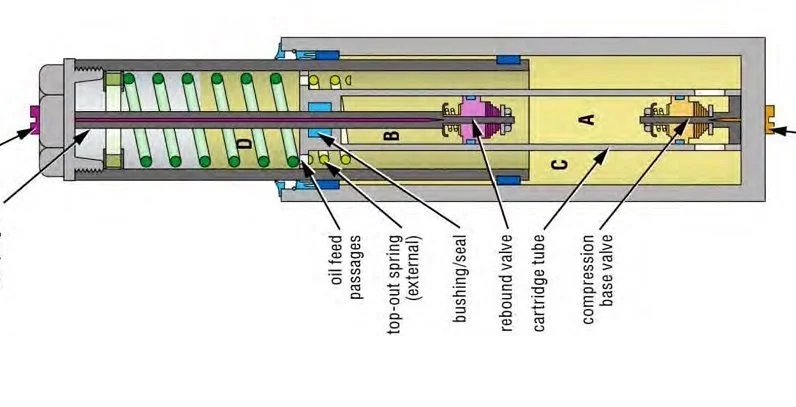
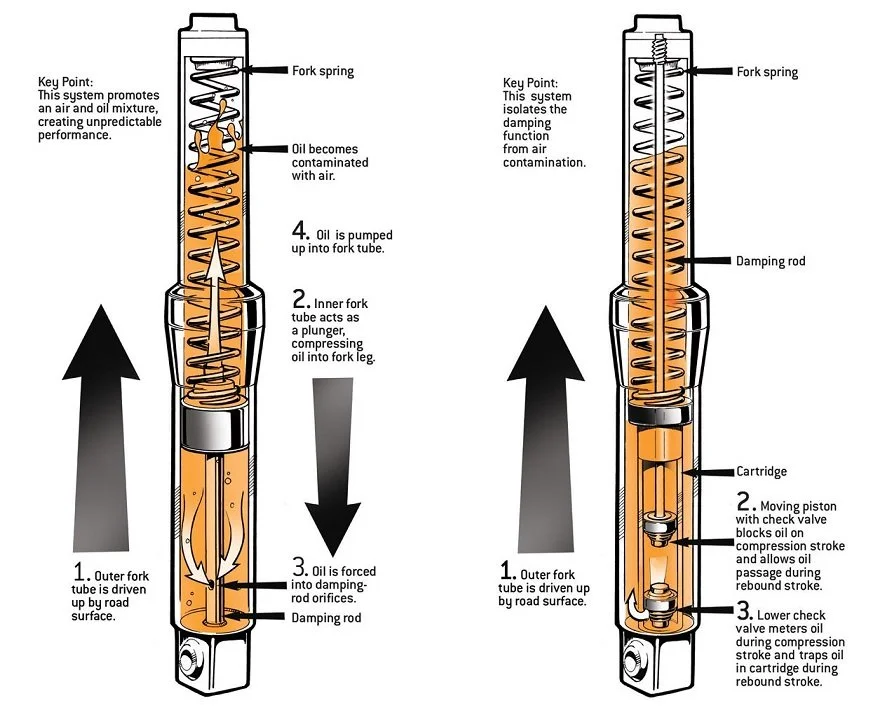
Inside your forks you will find in most modern bikes items called cartridges containing valves (or crudely sometimes called Pistons) and these valves are much the same as whats found in Shocks. So within the OEM suspension and more often that not these valves will be crude and cost effective to produce items. In years previous cartridges were expensive to produce and tended to be the domain of more expensive bikes and many manufacrures used what is called a dampening fork. So called because dampening of the spring energy was by forcing oil through smaller orifices. (holes) These forks (dampening) went through many changes and valves were invented (RaceTech - Paul Thede) that utilized shim stakes that in may cases mimicked a cartridge fork with exceptional results. Later came more advanced methods with improvements to the sealing of the dampening rods and both rebound and dampening control. Kiwis where very active with some of these designs and remain so but the major failing of these forks is cavitation as they returned the oil and bypass back to the fork reservoir. The later cartridge and “upside down fork” requires less oil. Compared to modern day cartridges they use small air gaps and that further encourages the cavitation. Modifications became exspensive and newer cartridge development meant cartridges could be produced way more cheaply and became almost like throw away in there construction.
With cartridges the cartridge could / can be replaced within the fork with way more sophisticated and adjustable units or often the cartridge can be dismantled and the valves replaced or modified with better technology. By replacing these items with modern machining and accuracy (CNC) the parts can be greatly enhanced that allows better oil flow, sealing, cavitation and pressurization. When Suspension Dynamometers were developed so to was the ability to further develop suspension without just trusting the seat of your pants. Workshops could track the development and behavior of there designs and parts without becoming encumbered with exhorbatant costs.
Front and rear suspension went from dampening devices controlled largely by springs to devices controlled by oil flow that made the energy stored within springs so much more controllable. Suspension today uses small piston like bodies with shims to control the spring energy. These bodies through thin flexible shims could control suspension compression and rebound (return of the fork) through the flow of oil through the distorting shims. These shims distort through the force / velocity which modern math has taught us is a constant or squared law. Of course to work all this out effectively and because the possibilities are enormous you need a Suspension Dyno and now the knowledge is just getting started. Then you have pre-load on the spring and that’s as scary a science (another blog) as it effects the sweet spot of the shim stack, now introduce oil flow through the offices or deforming shim stacks, oil flow is measured in centistokes (cSt) and defines an oil's resistance to flow under gravity through a known orifice so don’t be confused by the weight of Oil, like a 10w or 15w as these vary from one manufacturer to another, oh and spring weights.
Today many variations of valves and where they are placed exist, like shims on both sides of the valve body, giving both rebound and compression control through the one valve, Separate compression valves and rebound valves at the top and bottom of the cartridge to one fork being compression and one fork being rebound. This latter system has advantages in that both rebound and dampening can be easily adjusted where when both valves exist in the same fork it was often much harder to adjust without removing the axle.
Shim stacks are interesting in they tend to carry multiple shims that start at a larger diametre (Low force / Velocity - low speed opening of the shims) down to smaller diametre shims that give better high speed control. Then you can gain further control by introducing what is commonly called clickers, these clickers work by just allowing more or less oil to by-pass the shim stacks and so effecting the dampening of the forks speed or hardness. So if you close the clicker off (generally turning in a clockwise direction) you are lessening the oil that can bypass the valve (shims) which now makes the suspension harder or slower as the spring can’t use it’s energy so easily.
Of course the point of all this is to keep the tyre as it rides over the undulations to stay in constant contact with the surface. Oh one last thing if you have had your forks / shocks professionally built and dyno’d by a knowledgeable, experienced technician and unless your last name is Lorenzo you don’t necessarily need clickers.
I hope you are now a little enlightened to how the suspension controls the contact of the rubber with the road. Regards Leigh.